
How renewable power becomes pipeline gas
Two proven steps, electrolysis and methanation, packed into modular plants. What makes the difference is the reactor in the middle and how flexibly it follows the weather.
A reactor built from channels, not pellets
Conventional methanation uses a fixed bed of catalyst pellets. TURN2X uses a metal honeycomb body with many narrow channels whose walls carry the catalyst. Methanation releases heat, and the metal structure removes it quickly.
That is what allows fast load changes. The plant can run hard when renewable electricity is cheap and plentiful and turn down when it is scarce.
CO2 + 4 H2 → CH4 + 2 H2O
Illustration, not to scale.
The process, step by step
- Renewable electricityPlants are co-located with wind and solar parks. In Spain, power comes through a purchase agreement with Axpo Iberia, with Aquila Clean Energy supplying the renewable electricity.
- ElectrolysisWater is split into hydrogen and oxygen. Water and biogenic CO2 are the only inputs the plant needs.
- Biogenic CO2The carbon comes from biological sources. Placing modules directly at biogas facilities means the CO2 is already on site and does not need to be transported.
- MethanationHydrogen and CO2 react in the honeycomb reactor to form methane and water.
- Grid injectionThe renewable natural gas is chemically identical to fossil natural gas and reaches customers through existing pipelines.
Modules of 9 MW instead of one giant site
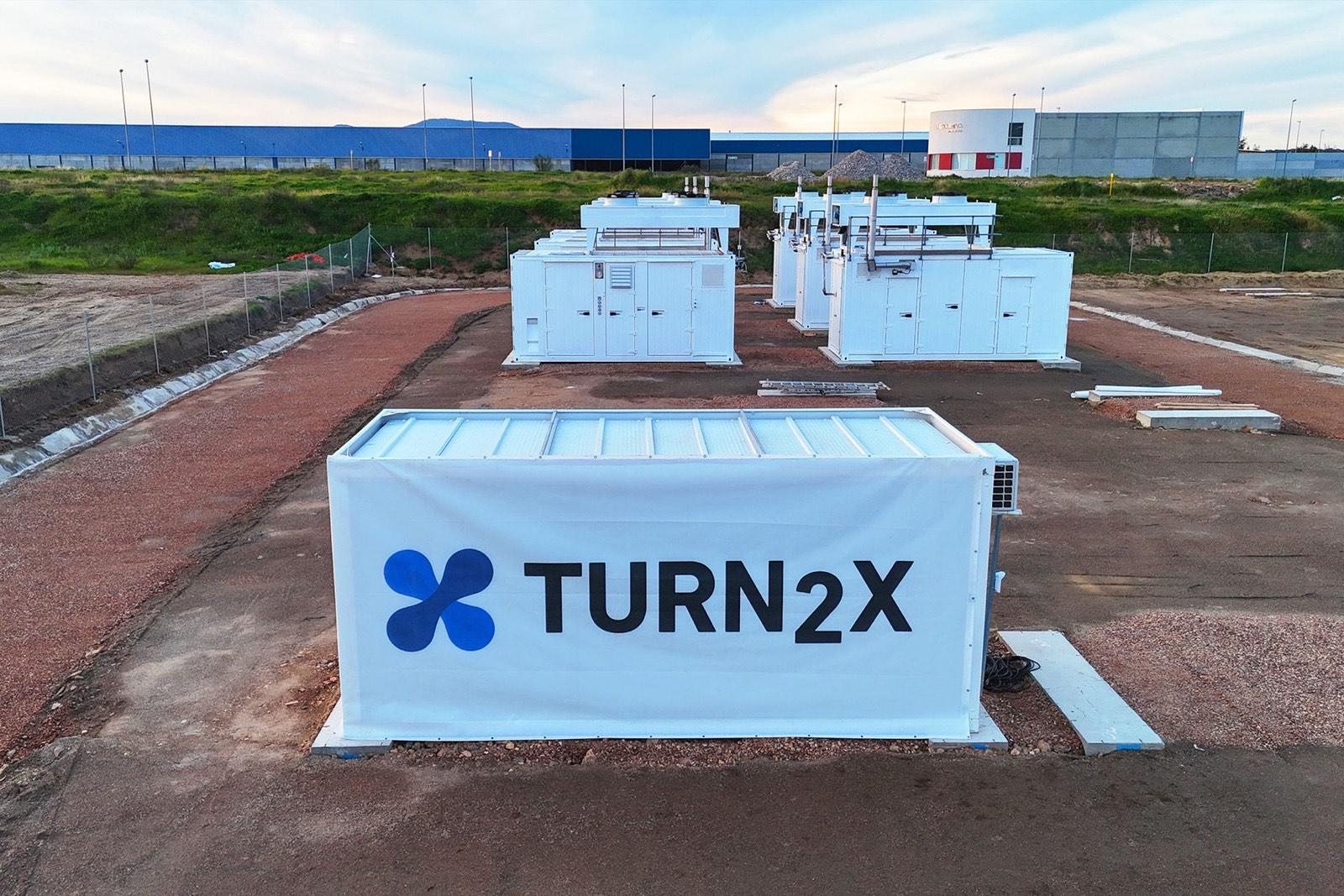
Many power-to-gas projects bet on large central facilities. TURN2X standardises on 9 MW units that can be placed where renewable power and biogenic CO2 already meet, for example at biogas plants.
In Miajadas the team needed less than six months from site selection to inauguration.
Certified renewable, under EU rules
TURN2X produces certifiable renewable natural gas that complies with the rules for Renewable Fuels of Non-Biological Origin (RFNBO). Axpo describes Miajadas as the first facility in Spain to produce methane as an RFNBO.
Regulation is pulling demand forward. On 23 April 2026 the Bundestag approved an update to Germany's greenhouse gas reduction quota with a rising minimum share of RFNBOs in transport. Industry sources estimate it at 0.1 % in 2026, 1.5 % in 2030, 5 % in 2035 and 10 % in 2040.
Source: Munich Startup
Ten years of methanation work
- 2012Research on methanation begins at the Engler-Bunte Institute of the Karlsruhe Institute of Technology.
- 2016First patents filed.
- 2018The Store&Go project secures a €26 million grant to build a first plant.
- 2019Pilot plant in Germany goes into operation and produces the first green molecules.
- 2023The next design iteration leads to further patent filings.
- 2024Inauguration of the first commercial plant in Miajadas, Spain.
- 2026€20 million Series A to build further commercial plants.